
Modern marketing teams are under relentless pressure. Campaigns need to move faster, perform better, and deliver measurable results—all while budgets tighten and expectations rise. Yet many teams still find themselves trapped in operational overhead, spending more time coordinating tasks than actually executing campaigns.
This imbalance is not just inefficient—it is costly. When marketers are buried in spreadsheets, approvals, and fragmented tools, creativity suffers, execution slows, and opportunities slip away.
Artificial intelligence is fundamentally changing this reality. By automating repetitive processes, connecting data across systems, and enabling real-time decision-making, AI allows marketing teams to shift their focus from managing campaigns to actually delivering them.
This is not a theoretical shift. It is a practical transformation already reshaping how high-performing teams operate.
What AI Campaign Execution Really Means
AI-powered campaign execution is more than automation. It represents a shift from static, manual workflows to dynamic systems that can plan, adapt, and optimize campaigns continuously.
At its core, AI-driven execution relies on the ability to process large volumes of data in real time and translate that data into action. Instead of manually deciding who to target, what message to deliver, and when to send it, AI systems make these decisions based on behavioral signals, historical performance, and predictive models.
This creates a level of responsiveness that traditional marketing simply cannot match. Campaigns are no longer fixed plans—they become living systems that evolve as new data emerges.
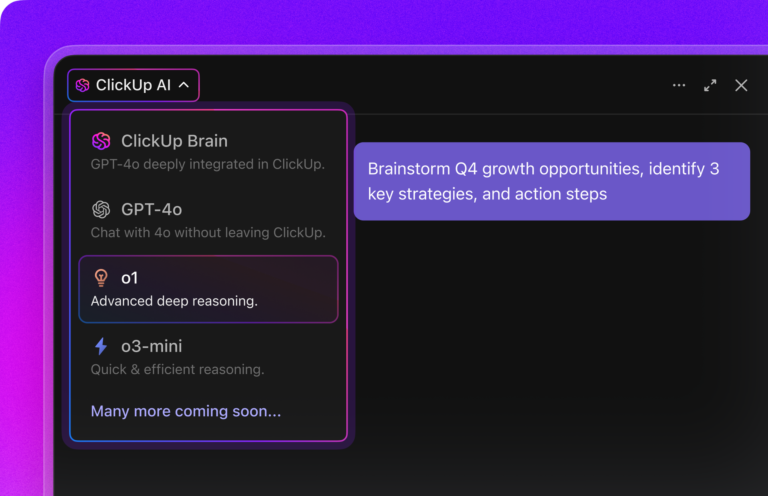
The technologies behind this transformation are diverse. Machine learning models identify patterns and predict outcomes. Natural language processing enables the generation and refinement of content. Large language models assist with ideation, messaging, and campaign structure. Predictive analytics forecast performance before significant budget is committed.
Together, these capabilities allow marketers to operate with both precision and agility.
It is important to understand, however, that AI does not replace marketers. Instead, it removes friction. It handles the repetitive and data-intensive aspects of campaign execution, allowing human teams to focus on strategy, storytelling, and creative direction.
Why AI Has Become Essential for Campaign Execution
The defining advantage of modern marketing is not just creativity—it is speed combined with precision. The ability to react quickly to trends, adjust messaging based on performance, and deliver personalized experiences at scale has become the difference between campaigns that succeed and those that fade into noise.
AI excels in this environment because it compresses the time between insight and action. When a shift in customer behavior occurs, AI systems can detect it immediately and trigger a response. This might involve adjusting targeting, reallocating budget, or generating new creative variations tailored to emerging patterns.
Personalization is another area where AI has transformed expectations. Audiences no longer respond to generic messaging. They expect relevance—content that reflects their preferences, behavior, and position within the customer journey. Delivering this level of personalization manually is nearly impossible at scale, but AI enables it seamlessly.
Equally important is the role of AI in improving decision-making. Traditional marketing often relies on assumptions or delayed reporting. AI replaces this with continuous analysis, ensuring that decisions are grounded in real-time data rather than outdated insights.
This combination of speed, personalization, and data-driven precision creates a powerful competitive advantage.
The Hidden Costs of Manual Campaign Processes
Many marketing teams underestimate the true cost of their current workflows. The inefficiencies are often accepted as part of the process, but they have a significant impact on performance.
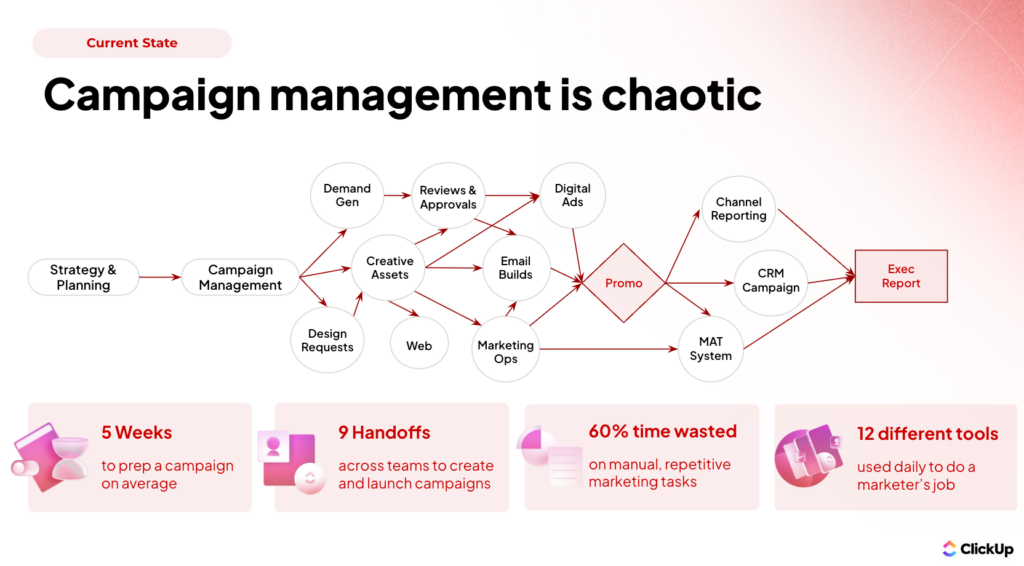
Fragmentation is one of the biggest challenges. Campaigns are typically managed across multiple tools—project management platforms, analytics dashboards, content systems, and communication channels. This creates silos where information is scattered, forcing teams to spend time searching, syncing, and reconciling data.
Manual data entry introduces another layer of risk. Errors, inconsistencies, and outdated information can easily creep into campaign workflows, leading to flawed decisions and wasted resources.
Delays are also common. Approval cycles, feedback loops, and coordination between teams slow down execution, causing campaigns to miss critical timing windows. In fast-moving markets, timing is often the difference between relevance and irrelevance.
Perhaps most importantly, manual processes limit creativity. When teams are consumed by administrative tasks, they have less capacity to experiment, innovate, and refine their messaging.
AI addresses these challenges not by adding complexity, but by simplifying the system as a whole.
Moving Beyond Spreadsheets and Traditional Tools
For years, spreadsheets have been the backbone of campaign management. They are familiar, flexible, and easy to use. But they are also fundamentally limited.
Spreadsheets are static by nature. They do not update in real time, cannot automate workflows, and struggle to handle the complexity of modern, multi-channel campaigns. As teams grow and campaigns scale, spreadsheets quickly become bottlenecks rather than enablers.
Traditional project management tools offer some improvements, but they are not designed specifically for marketing execution. They often lack the ability to integrate campaign data, manage creative workflows, or leverage AI for optimization.
The result is a system that still relies heavily on manual effort, even when better alternatives exist.
AI-powered platforms, by contrast, are built to handle the dynamic nature of modern marketing. They integrate data, automate processes, and provide real-time visibility, creating a unified environment where campaigns can be executed efficiently.
AI vs. Manual Execution: A Shift in ROI
The true impact of AI becomes clear when viewed through the lens of return on investment.
Manual processes are not just slower—they are more expensive. They require more time, more coordination, and more resources, all while delivering less consistent results. The hidden costs of missed opportunities, delayed execution, and inefficient workflows add up quickly.
AI changes this equation by increasing output while reducing effort. Campaigns can be launched faster, optimized continuously, and scaled without proportional increases in workload.
This leads to improved performance across key metrics, including engagement, conversion rates, and overall return on ad spend. At the same time, operational efficiency improves, allowing teams to focus on higher-value activities.
The result is not just incremental improvement, but a fundamental shift in how marketing teams operate.
A Practical Approach to Executing Campaigns with AI
Successfully implementing AI in campaign execution requires more than adopting new tools. It involves rethinking workflows, integrating systems, and establishing a balance between automation and human oversight.
The process begins with identifying where AI can create the most value. For most teams, this includes content generation, audience segmentation, campaign scheduling, and performance analysis. By focusing on high-impact areas, teams can achieve quick wins while building momentum for broader transformation.
Integration is the next critical step. AI systems must connect seamlessly with existing tools, including CRM platforms, email marketing systems, analytics dashboards, and asset management solutions. This creates a unified data environment where information flows freely and decisions can be made in real time.
Planning remains a human-driven activity, but AI can enhance it significantly. By analyzing historical data and processing meeting inputs, AI can generate detailed campaign briefs, identify potential risks, and suggest optimization strategies before execution begins.
Once the campaign is underway, AI takes on a more active role. It can generate content variations, personalize messaging for different audience segments, and automate distribution across channels. Approval workflows can be streamlined, ensuring that content moves quickly from creation to deployment.
The most significant advantage emerges during the optimization phase. AI continuously monitors performance, identifies underperforming elements, and suggests or implements adjustments. This creates a feedback loop where campaigns improve in real time rather than after the fact.
Measuring Success in an AI-Driven Environment
One of the most compelling benefits of AI is its ability to provide precise, real-time insights into campaign performance.
Metrics such as conversion rates, customer acquisition costs, and return on ad spend become more accurate when data is clean and continuously updated. AI also enables deeper analysis, revealing patterns and trends that might otherwise go unnoticed.
Beyond performance metrics, AI provides visibility into operational efficiency. Teams can track how quickly campaigns move from concept to execution, identify bottlenecks, and measure improvements over time.
Predictive analytics adds another dimension, allowing marketers to forecast outcomes and adjust strategies proactively. This shifts the focus from reactive reporting to forward-looking decision-making.
Challenges and the Need for Balance
Despite its advantages, AI is not without challenges. Its effectiveness depends heavily on data quality. Poor or biased data can lead to inaccurate predictions and suboptimal decisions.
There is also the risk of over-reliance on automation. While AI can optimize processes, it lacks the human understanding required for emotional resonance, cultural sensitivity, and brand storytelling. Without proper oversight, campaigns may become efficient but uninspired—or worse, misaligned with audience expectations.
Transparency is another concern. Some AI systems operate as “black boxes,” making it difficult to understand how decisions are made. This can create trust issues, particularly when significant budget allocations are involved.
Addressing these challenges requires a balanced approach. AI should be treated as a powerful tool, not a replacement for human judgment.
Ethical Considerations in AI Campaign Execution
As AI becomes more deeply integrated into marketing, ethical considerations take on greater importance.
Marketers must ensure that data is collected and used responsibly, with clear consent and transparency. Personalization should enhance user experience, not manipulate behavior or invade privacy.
Bias is another critical issue. AI systems must be trained on diverse and representative data to avoid reinforcing existing inequalities or excluding certain groups.
Ultimately, ethical AI is not just about compliance—it is about building trust. Brands that prioritize transparency and responsibility will be better positioned for long-term success.
Real-World Impact: AI in Action
The practical impact of AI-driven campaign execution can already be seen across industries. Brands are using AI to create highly personalized experiences, respond to real-time events, and scale their campaigns in ways that were previously impossible.
From dynamic advertising that adapts to local conditions, to interactive campaigns that engage users directly, AI is enabling a new level of creativity and responsiveness.
These examples highlight an important point: AI is not limiting creativity—it is amplifying it. By removing operational constraints, it allows marketers to experiment more, iterate faster, and deliver more impactful campaigns.
The Future of Campaign Execution
Looking ahead, AI will continue to evolve from a supportive tool to a central component of marketing strategy.
Campaigns will become increasingly adaptive, responding to user behavior in real time across multiple channels. Content creation will become more integrated, with AI generating and optimizing assets across formats, from text to video.
At the same time, the importance of first-party data will grow, as privacy regulations reshape how information is collected and used. AI will play a key role in extracting value from this data while maintaining compliance and trust.
Perhaps most importantly, the role of marketers will shift. As operational tasks are automated, the focus will move toward strategy, creativity, and innovation.
Conclusion: From Management to Execution
The adoption of AI in marketing is not just about efficiency—it is about transformation.
Teams that embrace AI can move faster, operate more intelligently, and deliver better results with fewer resources. They can shift their focus from managing campaigns to executing them effectively.
Those who resist this shift risk falling behind, not because they lack creativity or expertise, but because they are constrained by outdated processes.
The question is no longer whether AI should be part of your campaign strategy. The real question is how quickly you can integrate it into your workflows and start capturing its benefits.
In a landscape where speed, relevance, and precision define success, AI is no longer an advantage. It is a necessity.